 |
|
NON-FICTION
|
|
|
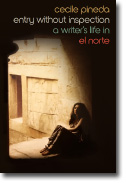
ENTRY WITHOUT INSPECTION:
A Writer’s Life In El Norte
Available from University of Georgia Press.
Paperback IISBN 978-0-8203-5846-8 • $25.95 • 8 1/4 X 5 1/4 inches
• also by ebook from regular suppliers.
Publication date: November 5, 2020
It was early 2009. News reports told of a woman, acting on her own, without much organizational backing, who had entered the New Jersey jails to render assistance to immigrants held in abysmal conditions by Immigration and Customs Enforcement (ICE).
News photographs showed her to be elderly, and diminutive, of no particularly distinctive appearance, a woman one could imagine knitting, a small cat curled up in her lap. It was that very ordinariness that drew my interest: despite it, she was the first whistleblower to expose a death in immigrant detention. Her discovery of that first “disappearance,” prompted a New York Times investigation which revealed that by 2009, within the seven years since ICE was first established, at least 106 more deaths had already occurred in the jails operated by Homeland Security, under the auspices of its Immigrant and Customs Enforcement arm.
I needed to find out what prompted her at the age of 75 to break out of an unremarkable life and to come to the aid of people apparently so unlike herself. In search of a story, I did something I had never done before. I took a plane to New Jersey. Over the next ten days I listened to her story until my notes took up a full journal. I discovered she was a Holocaust survivor. And yes, she was an accomplished knitter but she kept dogs, not cats. And quite unawares, I had begun to write the words that would overlay the story of my true beginnings, one I had not yet unraveled. But in the writing, I would bring together two apparently disconnected stories, one laid down in my early adulthood, one emerging much later in a life that could be seen as an improvisation by someone whose story until now has been a search for identity—a theme reflected in my voice-switching fiction—a story that in the drafting can be traced in a series of hatch marks, which taken together, reveal their true pattern over time, words written by someone whose family ties were severed and whose culture was cast aside at the U.S.-Mexican border when my father fled his country in 1910, and entered the U.S. under an assumed name, an extra-legal immigration referred to by ICE as “entry without inspection”, a story that returns to the year my father married my mother in 1931.
Cecile Pineda is a foundational voice in Latina/Latino literature. Every new book is cause for celebration. She is writing at full force. Read it. —Luis Alberto Urrea, author of The House of Broken Angels.
|
|
|
THREE TIDES:
Writing at the Edge of Being
Available from Independent Publishers Group.
Paperback ISBN 978-0-9303224-92-6 • $17.95 • 6 X 9 inches
• also by ebook
Publication date: November 1, 2016
In Three Tides: Writing at the Edge of Being, Pineda visits themes of displacement — personal, environmental and cultural — letting readers peer over her shoulder as she talks about writing, revealing the process that allows her to stumble, crawl and run. Grounded in memoir chronicling a particular period of writing, she moves on to documenting the devastation of Hurricane Katrina, mediated through the oral histories of some of its survivors. The receding echoes of those New Orleans voices surface once more in the tone poem "Like Snow Melting in Water: Song for a Lost Village." Based on a true story, the drama chronicles the life and death of a rice-growing village bordering the Sea of Japan. Pineda parallels the environmental devastation of Katrina — a catastrophe that wiped out entire communities of people and wildlife, erasing both culture and history — with the burial of a 300-year-old village and its magnificent landscape beneath a toxic landfill by a waste disposal company. Productions have been staged in India and Thailand.
Pineda is known for both her mold-breaking fiction (Face and Love Queen of the Amazon) and her urgent environmental writing (Devil's Tango: How I Learned the Fukushima Step by Step, and Apology to a Whale: Words to Mend a World.)
“Writers, readers, teachers, and creative writing classes, take note: Cecile Pineda is an American original, a literary treasure…. Her prodigiously inventive and important work…deserves a place in the forefront of American literature.”
—Jeff Biggers, in Bloomsbury Review
“Cecile Pineda is a writer of the utmost artistic integrity.”
—J.M. Coetzee, 2003 Nobel Prize
“With characteristic brio, Cecile Pineda has twisted three strands of imagination, scholarship, and spectacle into one strong thread, leading us through a wild and watery labyrinth of the creative process and out again, emboldened and very much wiser for having made the journey. Brava!”
—Rosemary Catacalos, Poet Laureate of Texas
|
|
|
APOLOGY TO A WHALE
Words to Mend a World
Available from Independent Publishers Group.
Paperback ISBN: 978-1-60940-440-6
Simultaneous Ebook editions (prices will vary according to retail source):
ePub ISBN: 978-1-60940-441-3
Kindle ISBN: 978-1-60940-442-0
Library PDF ISBN: 978-1-60940-443-7
"Cecile Pineda has the nerve to ask the one simple question that eludes our public posturing....It is the one question that could save us: What has happened to our mind that we are killing our world? What is it, at the root of our culture that sets us against the rest of creation? The genius of this book is that the question [itself] supersedes the answers and takes us on explorations where we make our own discoveries. These widening apprehensions not only pierce us with heartache for what we have lost, but invite us to examine the imprisoning structures of the very language we use. Cecile Pineda has the rare and enviable capacity to address the big questions without falling into abstractions or sermonizing. It is the artist in her that I trust, and that utters so potent a call to personal and collective liberation.”
—Joanna Macy, author of Coming Back to Life
"Unfolding like an ancient book of days, Apology to a Whale contains the insight of a naturalist and the spell-binding stories of a sage....Few writers have the ability to make us see the world in such a different way; to challenge readers to consider the still small possibility of restorative justice for our planet.”
—Jeff Biggers, author of Reckoning at Eagle Creek
From Apology to a Whale:
2. The Art of Apologizing
When the Indians all die, then God will let the water come down from the north. Everyone will drown. That is because the White people never cared for land or deer or bear…. The White people plow up the ground, pull up the trees, kill everything. The tree says, “Don’t. I am sore. Don’t hurt me….” The Indians never hurt anything, but the White people destroy all…How can the spirit of the earth like the White man..? Everywhere the White man has touched, it is sore.
—Kate Luckie of the Wintu Nation
How do you apologize to a whale? What can you tell it that it may not already know: how the seas in which it migrates thousands of miles each year are becoming more acidified with each season that passes. How the waters turn warmer, displacing the denizens of the temperate waters farther towards the melting icecaps? How the bodies of the small fry in the northern waters gape with the same ugly blood bruises of radiation sickness that surface on the skins of people living in Japan? How the larger fish eat the small fry, concentrating radiation upward in the food chain? How do you explain how one species, and only one species on earth has insisted on dominion over all things, driving the dynamic of its planetary habitat to chaos and collapse? What do you say? Do you tell it why in its migrations it must avoid the sea of plastic detritus big as Texas spiraling slowly in a now lifeless sea once teaming with plankton, and all forms of life. Tell it to steer clear from the very depths to the place where water meets sky where it breeches for air between its hour-long dives? How would you explain—or justify—something impossible to justify?
Would you offer the Earth’s gaping wounds, its carbon emitting smokestacks, its fracking sites, its radiation-contaminated grounds as consolation? Or the feeling of entitlement in the western world to drive exhaust belching cars, to fly planes, to contaminate its rivers and streams, to clear cut its own lungs, the trees; to kill everything that moves? to wage perpetual war for wealth and aggrandizement, and because one nation can blackmail another with knowledge of its secret acts, to decimate its own species by the millions and to leave behind a poisoned earth wherever its armies bivouac?
Would you begin to ask yourself—or explain—where in time your minor species started to go wrong? Was there such a moment? Why did it come about? Were there several such moments? How would you explain the imperviousness of the Princes of the Earth as they go about the business of business, insulated in their high-rise air-conditioned boardrooms, and in the hallways of Empire where the deals are struck and where mountain-by-mountain, forest-by-forest, invasion-by-invasion, assassination-by-assassination, they condemn the Earth to die?
Would I explain that—justify that—to a whale? Could I imagine making excuses, knowing all the while that my species was hell bent on starving it, evicting it from its habitat? Would I comfort it by telling it how once its blubber was boiled down to light the night, as oil is taken from the darkness of the earth to make light, the most exquisite thing on Earth?
What might be the whale’s response—assuming I were intelligent enough to hear it?
Cecile Pineda talks about the environment, September 11, 2013:
http://womennewsnetwork.net/2013/06/11/radio-on-air-post-fukishima/
|
|
|
Devil’s Tango: How I Learned the Fukushima Step by Step,
236 pages
Available from Independent Publishers Group.
ISBN: 978-0-916727-99-4, paper $16.95
EPub ISBN 978-1-60940-234-1
Library PDF ISBN 978-1-60940-236-5
Pineda’s astonishing anatomy of the Fukushima Daiichi nuclear disaster is an alarming cry from the heart that echoes the best work of Rachel Carson….It is a work of conscience truly in touch with, and deeply concerned about, humanity.”
—John Nichols, author of The Sterile Cuckoo, and The Milagro Beanfield War
From Devil’s Tango:
1. Habitable Zones
We picked out planets that are just the right size—between the size of Earth or twice that—and all are within the ‘habitable zones’ of their stars, at distances where there’s the best chance for liquid water—and possibly life—to exist.
— Dan Wertheimer, space sciences lab astrophysicist
There is no place more wonderful than this. There is no place more marvelous than here.
—Milarepa
Starry night. All along the horizon, telescopes rotate, staring at the night sky: the Atacama Desert, where the skies are transparent like no other place on earth, free of the pollution of city lights, and of temperate zone moisture.
The human race is looking for planets. Hungry for planets in our own image, in the image of Gaia, of Earth. Planets near enough yet far enough from their distant suns not to burn up, not to freeze. Planets which show signs of water in their atmospheres. Planets that revolve around the maybe 50 billion stars in the local galaxy, in the neighborhood we call the Milky Way, and in the narrowest possible tranche of it, 1,235 planets have been sighted that correspond to such spacial parameters, and of those 1,235, 86 stand out, 86 which answer within reasonable limits to those conditions: sufficiently distant from their suns (but not too distant) to entertain the possibility of water.
Imagine 86 watery planets, each with its own orders of life: its own set of one-celled organisms, of invertebrates, of phyla inherited from a primordial past, of the first cone-bearing trees, of the first flower bearing plants, of mammals, of insects, of trees, and shrubs and flowers. Imagine 86 planets with their own hereditary, evolutionary lines culminating or perhaps on the way to culminating in sentient, intelligent beings with appendages to hold tools, to compose music, to create dance, with tongues to bend around the syllables of languages structured entirely other than any Earthlings can begin imagining. Eighty-six planets with their own dynasties of composers, choreographers, writers, poets, singers of songs. Take all the sounds of all the languages of 86 planets, and all the sounds of all the music of 86 planets, meld them together, imagine the chorus. Now turn down the volume to a whisper: the whisper of the sounds made by the sentient beings of 86 planets. That is only 1/600,000,000th of the sounds of all the neighborhood galaxy’s planets, and, of the universe’s, a fraction so unfathomable human cognition cannot imagine it.
But this one, this Earth, this Gaia is the one you have. This one, and only this one. Its rocks, its fossils, palimpsests of times more ancient than time, its petroglyphs of a mankind more ancient than language, more ancient than writing. Its horsetails and ginkos, survivors of an unfairytale age of dragons, of cone bearers, of spore bearers, of molds, of microorganisms, of nematodes, of annelids, of the lowliest of beings without which none of our living, none of our songs, or our musics, or our dances, or our writings or our tongues could ever have been possible.
This Gaia is all you have.
Cecile Pineda talks about Fukushima and the nuclear industry, November, 2011: http://youtu.be/YHXsjX5H1sM
|
|
NOVELS
|
|
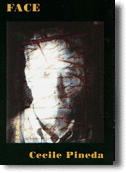
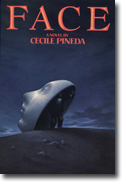
|
FACE, 175 pages.
Available from Independent Publishers Group.
ISBN 0-930324-90-0
FACE, Viking, New York, 1984, 194 pages, (out of print).
Contemporary American Fiction series, Penguin, New York, 1985
(out of print).
"When I read Face in 1985, it struck me as an extraordinary
achievement, all the more extraordinary for being a first novel.
Rereading it has not changed my estimate....Face continues to haunt me."
-- From the foreword by J.M. Coetzee, Nobel Prize, 2003.
"The author reveals the immense power of human will and
obsession; an original, complex portrait of survival."
Cathy Colman, New York Times, April 28, 1985
From Face:
HE IS wandering the street outside. It is dark, no moon, only
the kerosene lights glow red in the doorways. The windows are
shut tight against the night air. Something is different, uncanny.
No trace now of cobblestones, only the lightness of this feeling,
his feet barely touching, effortless, like riding a bus, or flying,
skimming over the surface quickly, like a dragonfly over water,
yes, and feeling what? Some kind of freedom. And then panic.
Touching. Touching to make sure. Why isn't the handkerchief there?
Why is his face exposed? Someone has died. And sharp, with that
knowing, row upon row of dimly powered lamps swing naked from
wires overhead, bright streets (dark only a moment ago) fill
with walkers, all solemn, hatted, in a ceremony closed to him,
all with handkerchiefs over their faces. And the signs painted
red over the doorways: "Moved," Closed," "For
Sale," "Deceased."
He was about to enter the picture show, a room plush, velvety;
wine-dark like the soul, and there to take his seat. He was supposed
to be there. He had been called. Something there, a welling cloud,
a balloon of blue air, now bulging, now concave: eyes, brows,
cheekbones, a vast blue Madonna with sad eyes, pulsating, breathing
mercy at him, her sad smile, blue lips, skin now pulsing, throbbing
with light, each cell opening like a pore, and in each pore,
each cell, a face, hundreds of faces, each throbbing, pulsing
with its own light."
Cecile Pineda reads from Face at the San Francisco Public Library, February, 2014: https://www.youtube.com/watch?v=Wn9Wxn_qcww
|
|
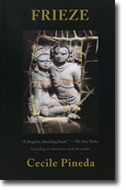
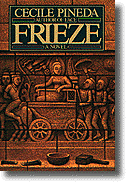
|
FRIEZE, 175 pages.
Available from Independent Publishers Group. ISBN 0-930324-91-9
FRIEZE, Viking, New York, 1985, 224 pages (out of print)
Contemporary American Fiction series, Penguin, New York, 1986
(out of print)
"As delicately phrased as a prose poem. A parable that opposes
the pride and power of the state to the slow resistances of human
life."
Richard Eder, Los Angeles Times Book Review, Nov. 16, 1988
"Elegant form and vigorous detail give Frieze its
mesmerizing power. The pure distance of it is mouth-watering,
like a sweepstakes vacation."
Josephine Humphreys, The Nation, November 15, 1986
From Frieze:
"Perhaps it began there, this journey into night, perhaps
it was then: the point where return was no longer possible, return,
if return could be, to something remembered or something perhaps
that never really was.
Looking back, it seems to me that everything had color at the
beginning: the sweetness of the days following one another, the
sandstone, the stoneyard, the candy vendor beating his water
harp--bright color, as if childhood ran way past its time, playing
tag with rainbow powder, every day a feast.
Yet when I think, before the darkness--my own--long before. .
. Some gray dawn--not just the stone--overtook me in mist, exiled
me to a world of black or gray, condemned me to pry apart the
porousness of a stone gone dark, forgetful of the fire that gave
it life, that spilled it from the stony womb of earth and sent
it coiling down dark hillsides, trailing sparks in the night
with each sweep of its serpent robes, stone tongues licking,
devouring the rice, setting fire to whole villages, entombing
the living with the dead, feeding, ravening, till sated, it curled
up at last and went to sleep.
Even now, touching it, prodding it with my chisel, even disguised
in the commonplace of these ornaments for hire, does the stone
remember? Does the chisel remind it of the fire?"
|
|
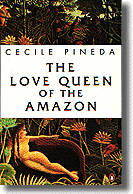 |
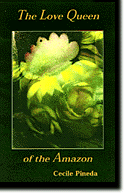
LOVE QUEEN OF THE AMAZON, 283 pages.
Available from Independent Publishers Group. ISBN 0-930324-69-2.
Paperback, 254 pages. $17.95
THE LOVE QUEEN OF THE AMAZON, Little Brown & Co., Boston,
1992-1993
255 pages, (out of print)
London, Hamish Hamilton, 1992
Munich, Bertelsmann, 1993-1994
Amsterdam, Uitgeverij-Arena, 1994
Penguin, UK, 1992
"Ana Magdalena Figueroa is one of the few great Latin heroines
not created by the male imagination. Cecile Pineda has enhanced
the roster of modern literature's most remarkable female characters
with her brilliantly drawn portrait."
Richard Martins, The Chicago Tribune, March 8, 1992
From The Love Queen of the Amazon:
"Many years later Ana Magdalena could remember only
the hold of that ship where destiny had led her. She could still
picture the hull made of carefully fitted, tarred planks of wood.
But there her memory stopped altogether, because all she could
imagine was that the floor of the hold had been covered with
flowers, a solid bed of them, and that she must have rolled on
petals fragile as the wings of night moths, and that their bodies,
hers and Sergio's, had been coated with the powdery, moon-colored
dust of the wings of cecropias, and that the linens were of the
massed and funereal petals of faded chrysanthemums; and that
when he pressed his mouth to hers, she felt the ephemeral beating
of a humming bird's wings, and that when he entered her at last,
her body raised its bone spoon to another of his lips and that
she became the exquisite tube of the moist, night-blooming cereus,
and that she held him in the sticky sap of her embrace like the
wriggling and pathetic tarantula that squirms helplessly before
dawn when the enzymes began their slow process of liquefaction
and returned their bodies to their ancient roots at the fountains
of the oceans, in the blankets of the fog. All this she imagined
in the twinkling of an eye, or perhaps an eon. And of the myriad
moments of her life that she reviewed throughout her time thereafter,
and even at the moment of her death, it was always this one that
stood out from all the others as the most satisfying.
But for Sergio Ballado, satisfaction was quite another matter.
He had plans. He was going to be rich. "Listen, woman,"
he said to her, "there's no room for us in this pissant
town. Why don't we both get married. . . ? Tomorrow I'm leaving
for Bélem. I'm going to work the excursion boats for the
rich yanquis who go upriver to shoot game. And when I get back,
I want you to be waiting because I'm going to come back rich!"
|
|
|
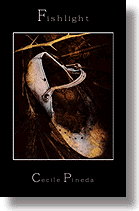
FISHLIGHT: A DREAM OF CHILDHOOD , 103 pages
Available from Independent Publishers Group.
ISBN 0-930324-67-6 paper $16.00
ISBN 0-930324-73-0 hardback $22.95
"Fishlight is a gentle, beautiful book, a rare
and poetic song from an exquisitely melancholy childhood, written
with heartbreaking innocence and a great love of life. It is
original, poignant, profoundly simple and unforgettable."
John Nichols, author of The Milagro Beanfield War
From Fishlight:
There was a little house, just an ordinary house. It had
everything inside: it had a bed, and a table, and a dryer to
hang the wash out over the stove, and every time the water boiled,
the shirts would wave their crazy arms, my father's long johns
shook and shimmied, and my mother's white opera gloves played
the piano till the fingers glowed red over the gas jets.
Inside his room you could see my father reading his book
till he nodded in his chair and when he fell asleep the pages
would flutter and turn over on his lap. In the kitchen you could
see my mother shelling peas and getting dinner ready.
When my mother called him to supper, my father woke up
with a snort. His head would snap back on his neck the way it
was supposed to, and the pages of his book would stop turning
over and smooth themselves flat. He would close the book with
a bang and slip it in the dark place where he hid things under
his easy chair, and when he stood up the world didn't go backwards
anymore. But when he went in the kitchen, his chair sucked in
all the lamp light till it swelled up like my mother's bread
dough, only in the kitchen, my father got so little, my mother
had to tie his napkin under his chin so he could eat. He kept
banging on the table with his spoon till my mother brought him
his Portuguese sardines. She had to open all the tins for him,
but she cut herself every time because the tins never had any
keys. She was always licking the blood off her thumb.
I was small enough to get inside the house, but they didn't
know which house I was inside of, the big house, or the little
house.
Cecile Pineda reads an excerpt from Fishlight, June, 2014: http://youtu.be/ki8YyYPJDLk
|
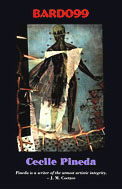 |
BARDO99, 80 pages
Available from Independent Publishers Group. ISBN 0-930324-83-8, paper $ 14.00
From Bardo99:
The tenth floor corridor gives on the isolation ward. There must
be some 20 or so bunks in rows to either side. Patients perch,
some of them, on the edge of their beds. Some sit quietly at
the far end of the room where they have grouped their bedside
chairs. There is no talking. One man vomits quietly into a kidney
basin.
Outside the weather is rainy, overcast. One of the buildings
is partially collapsed. On the roof a crew in lead contamination
aprons shovels the debris into wheelbarrows, civilian workers
probably, or scheduled populations. In the far distance, he can
see robots lumbering back and forth, pushing debris off a ledge.
Most of it rains down onto a dump truck parked below. Behind
it, rows of empty trucks await their turn, engines idling, spewing
exhaust in the wintery air.
--You have instruments here I can use, no doubt?
--Instruments? Lipsey and Chernoff look at him blankly.
--I was told not to bring my own.
Chernoff seems troubled.
--I see.
Lipsey clears his throat.
--What we have here is a ward where we assign only people who
were either present at the time of the explosion, or exposed
immediately afterwards. (He drops his voice.) All of them have
received ...
--doses beyond acceptable limits, he offers, nodding emphatically
to show he understands.
--Exactly, Chernoff picks up. Unfortunately, their prognosis
is not at all encouraging. Foreign experts--Dr. Fault among them--are
of the same opinion...
--Yes, I'm aware of Dr. Fault's assessment...
They have come to a stop beside an empty bed.
--You're probably wondering why they have assigned you here...
--The CRO unit wants me to further my training the better to
respond in such emergencies
--Yes, of course. That would normally be the case...
--Unfortunately, Lipsey clears his throat, unfortunately here,
no one is--shall we say--immune. We (he indicates his colleague)
have been assigned because until now we have received no exposure
whatsoever as far as anyone can tell. We will be here for 24
hours to minimize our own risk. We will be evacuated when another
fresh CRO team takes over. This evening, to be exact.
--And I'm prepared to assist in whatever way I can...
Chernoff clears his throat.
--I'm afraid you don't quite understand...
--Understand...? He stares at Chernoff in silence.
--Well, says Lipsey, don't you want to know why they assigned
you here?
--My orders...
--No. Your orders are unsigned.
|
 |
REDOUBT, 70 pages
Available from Independent Publishers Group.
ISBN 0-930324-86-2, paper, $14.00
"If you're a writer or a serious reader, looking for prose that takes you to the type of places where few have successfully kept your attention before, pick this one up. Redoubt is told through the mind of one unfathomable woman permanently relegated to warn of imminent invasion by the Enemy. Redoubt will carry you into an emotional maelstrom where Apocalypse would seem like liberation, in contrast to the heroine's timeless solitude. Enmeshed in an existence more Huit Clos than Sisyphus's most dreaded nightmare, it will carry your unwilling Self into niches of life never described in any dictionary. Redoubt is as close as I've ever come to "being one" with a woman, through the pages of a book."
Rudy Garcia http://labloga.blogspot.com/2007/06/bloodsuckers-quinones-like-son-redoubt.html
From Redoubt:
Hear that struggle in the corridor? Press your eye to the
keyhole. See her in there? Like a egg, she is. All sugar ruffles,
pink pastel, fresh from the pastry tube. Smart, ahn't she? Give
herself airs, a duchess at the very least, long fingernails lacquered
vermilion, pressing the mouthpiece to her gums, pouting-like,
pulling on her hookah, sucking on the tube, drawing the air in,
making bubbles in the bowl. See her in there? Like a clown she
is, legs spread, peaked cap, hectic spots of rouge, the fluted
ruff, the garish wig, tight henna'ed curls. Watch now. See if
you can stand on tiptoe. See? It's them! The hockey team! thundering
down the chute! millions of them, piling up in their sweaty best.
Throwing their weight against the gate. Bending it, bulging it,
bowing it, BANG! splinters flying! The big one there, the fatty,
see him streaking through the clutter of shin guards, sticks
and pricks, ahead of all the others now, charging for the puck,
huff and puff, a hero at the very least! Hurling himself on the
shining, shimmering splendor. CRACK! The yolky lake spreading
its golden puddle on the floor. What a mess! See him now? on
all fours? lapping it up, licking, licking in there, head first,
swallowed up. Ah, yes, ah, yes: the spider bleeds the soft stuff
white, while in the corridor the also-rans lie dying. Can you
hear it? out there? It's them. See them clowns, all cyclops eyes,
squinting through the keyhole? Peering at you? Grinning? Trying
to make you out in the obscurity? They're pulling on the guy
ropes, hauling you in. They're sure it's you. You can hear everything
they say. See them straining for a look? Row on row of them:
painted faces, scruffy ruffs, the smudgy white, red noses pressed
to the pane, smeary red lips, scarlet-stained teeth. Grinning,
waving, clamoring, pushing. Can you see them now? red pompons
bobbing, hurling confetti? shouting SURPRISE!!!"
|
|